Best Plastic Free Coffee Machines
What are the best Coffee Machines without Plastic?
The avoidance of plastic in coffee or espresso machines is a question I get on a weekly basis. People don’t want any plastic in their espresso or coffee machines, especially in the parts where hot water is located. Often, people also want to avoid aluminum and teflon as well.
So, that begs the question: are there any such machines that operate completely without plastic? If so, which types of machine are out there, and how easy are they to use, compared to the standard coffee maker? Stay tuned to read the article, or check out a list of machines here: Amazon List.
What are the best selling coffee machines?
Before we look into plastic-free coffee makers, let’s consider a standard coffee maker. In fact, let’s consider the best selling coffee maker on Amazon. This would currently be the “12 Cup Coffee Maker” by Black and Decker. It sells nearly 20,000 units per month.
Looking at the above machine, you can see that besides the glass carafe, nearly the whole thing is plastic:
- plastic chassis
- plastic water reservoir
- plastic water distribution
- plastic dripper
Well, of course the above machine is also very affordable, which is probably why so many people buy it. But, let’s look at some options that use less, or NO plastic.
Best Automatic Coffee Machines with little Plastic
As with the Black and Decker above, there are many automated coffee makers, but not many that limit plastic. Even the very expensive Fellow Aiden is nearly completely plastic.
So far, the best fully automatic filter coffee maker that I know comes from the Netherlands. It’s the Technivorm Moccamaster – an iconic brewer that is still made in the Netherlands, and for which you can also buy spare parts easily. So, they last a long time.
The Moccamaster uses more metal and glass parts than your average coffee maker from Walmart. You will see that the body is made out of aluminum, the heater is made of copper, the water distribution is via stainless steel shower bar, and the carafe is glass. Also, the hot water stem is made of glass. Quite nice materials.
It is however not entirely plastic-less, as the water reservoir is made of plastic, and the dripper as well. To be fair, the water in the reservoir is at room temperature, and you could consider using a different dripper if you so inclined to do so. The plastic parts are BPA/BPS/BPF & phthalate-free, according to their website.
The Moccamaster makes a delicious, clean cup of filter coffee, and it uses the standard 1:15 or 1:16 coffee powder to water ratio.

- Perfect Coffee Every Time: This pump-free coffee...
- Brew-Volume Selector switch for brewing half or...
- Easy to Use: The Moccamaster brews a full 40 oz...
- Quiet and Safe: The Moccamaster Select quietly...
- Delicious Coffee and Peace of Mind: Moccamaster...

Totally Plastic Free Coffee Maker?
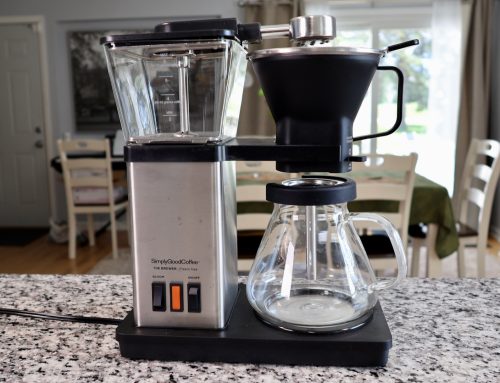
While the Technivorm above is mostly plastic free, the brand SimplyGoodCoffee has kind of copied the design, and actually replaced the plastic parts with metal and glass. Therefore, you will see that it has a glass water reservoir, while the following is made out of stainless steel:
- Boiler
- Percolation stem
- Shower rod
- Shower screen
- Dripper
This machine seems to function really similarly to the Technivorm above. I would however read through the Amazon reviews, as some people have issues with reliability of the brewer.
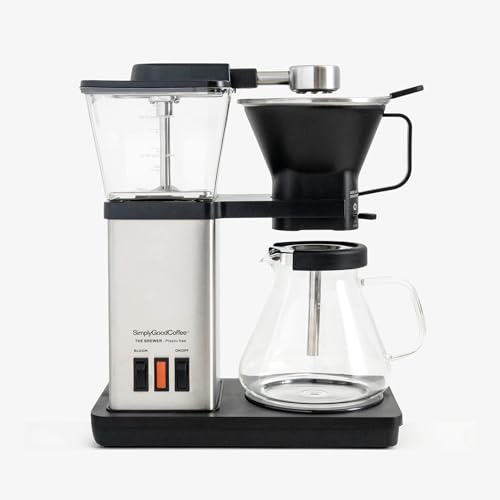
Plastic and aluminum free coffee brewer. Boiler, percolation stem, shower head and dripper made out of stainless. Carafe and water tank made out of glass.
AeroPress Premium
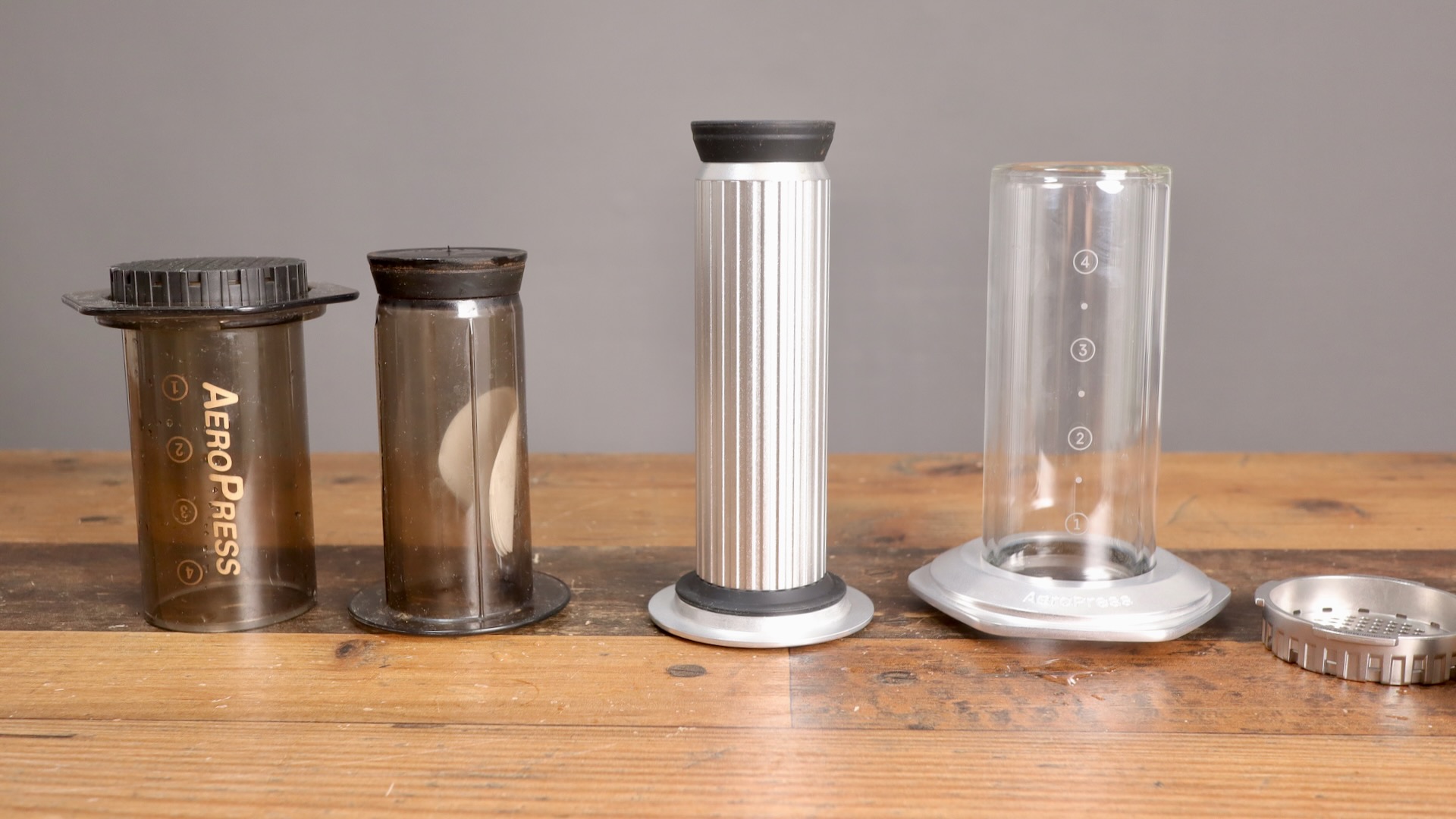
AeroPress is one of the best known brands on the market, regarding home coffee. They make delicious, bold and flavorful cups of coffee, and they are easy to use. They started with a plastic brewer, which is very economically priced. In the meantime though, they have now made a premium version, made out of better materials.
The AeroPress Premium is made out of double-walled borosilicate glass for the column, it has a super heavy stainless steel filter cap, and a plunger made out of anodized aluminum. Only the gasket of the plunger is made out of rubber. On top of this, the stirrer and dosing spoon are made out of stainless too. It’s a very nice unit to use, but pricey.
Bialetti Moka Express – Coffee Maker without Plastic Parts
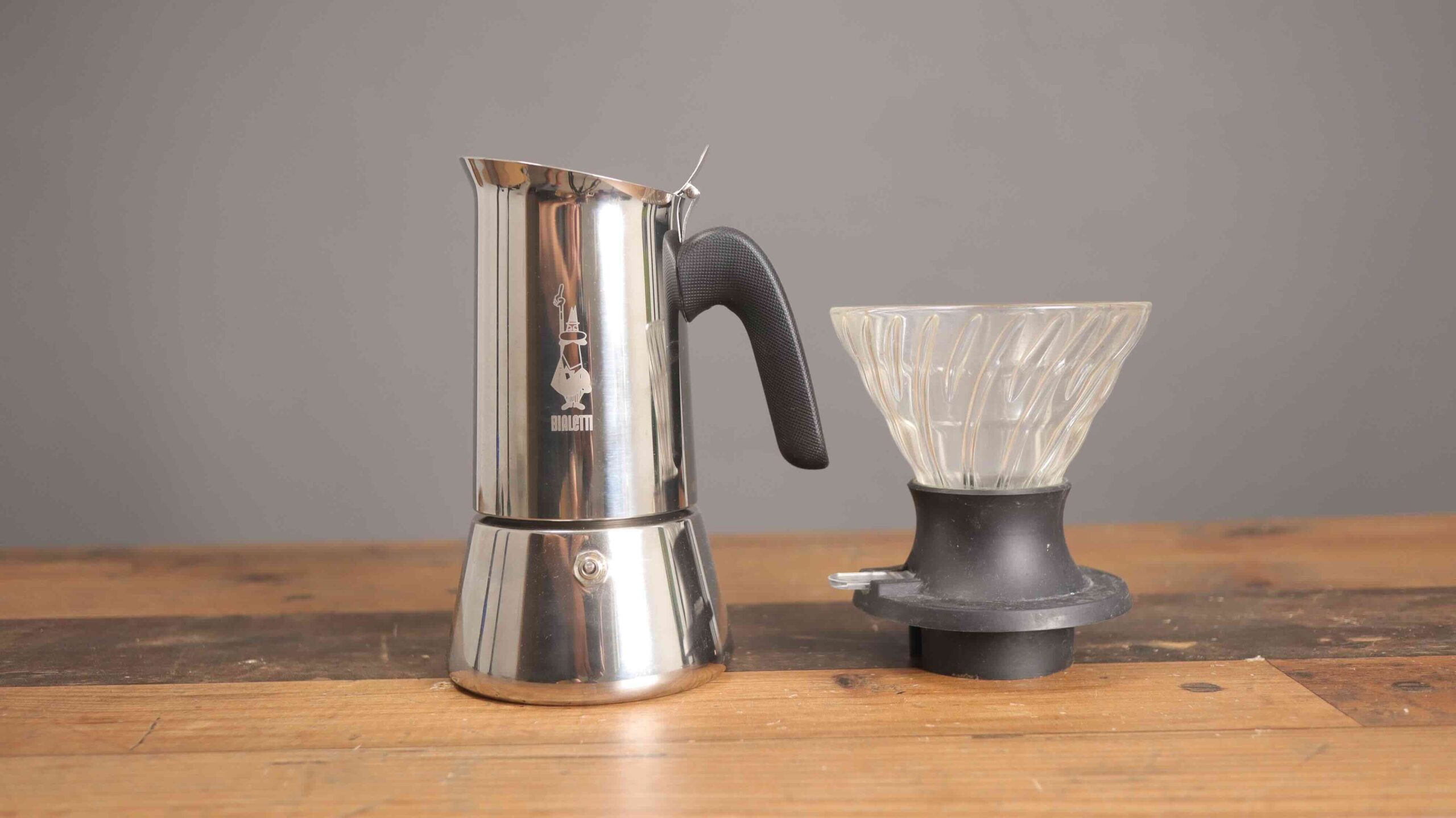
Another great option for a coffee maker without plastic parts is the Bialetti Moka Pot. It is made solely from aluminum or stainless steel, and it has a rubber gasket. Well, the handle is plastic, but that’s it. The Bialetti is also super cheap, and pretty easy to use and maintain. This is the absolute standard in Italy, and you’ll find at least one in each household. It makes a strong coffee, somewhere between an espresso and filter coffee, with about a 1:8 ratio.
I do find the newer stainless steel Bialetti Venus to be quite a handsome brewer, and with its percolation stem, it seems to be a little quieter too. The Venus is made out of 18/10 food grade stainless steel, and has a silicone gasket inside.

Now, when choosing a Bialetti, you have to know what size to get. I have both of the above variants in ‘6-cup’ size, which is measured in single espresso cups. So what I actually get out is 3 double espresso cups, or about 210 grams of coffee in the cup.
Therefore, about 275 ml of water fits in the chamber, 25 grams of coffee powder is added to the basket, and the yield is about 210 grams of finished coffee. That gives a ratio of about 1:8. The 6 cup is enough for my wife and I to split. For a single person, I’d suggest the 4 cup.
You are currently viewing a placeholder content from YouTube. To access the actual content, click the button below. Please note that doing so will share data with third-party providers.
More InformationWhat about Cold Brew?
Something you might overlook, but which is getting very popular lately, is cold brew. With this method of brewing coffee, you can choose your own container, and brew the coffee overnight. You can for example use a French Press to extract and strain the coffee, or even just a mason jar.
To make cold brew coffee, simply coarsely grind about 100 grams of coffee, and add 1 liter of water on top. Stir gently, and put in the fridge for 8-24 hours. Afterwards, strain out the coffee particles, and you’re left with cold brew coffee.
This trend is becoming popular, because cold brew is not only refreshing in the summer, but also makes the coffee less bitter and more sweet. Might be worth a try, if you want to go plastic-free!
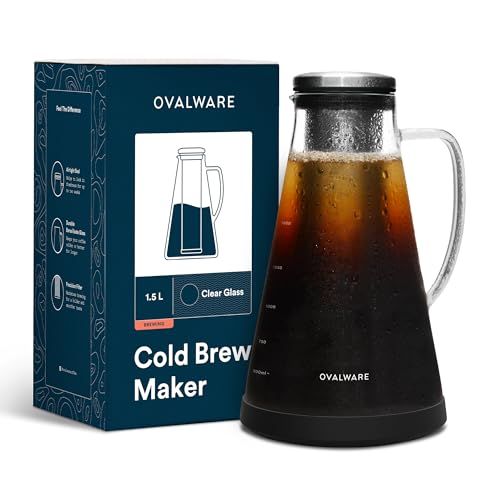
So, you can choose something like the carafe below which is a little pricey, or just use an existing large mason jar, and sieve the coffee bits out later.
Presto Percolator – Coffee Maker with no Plastic
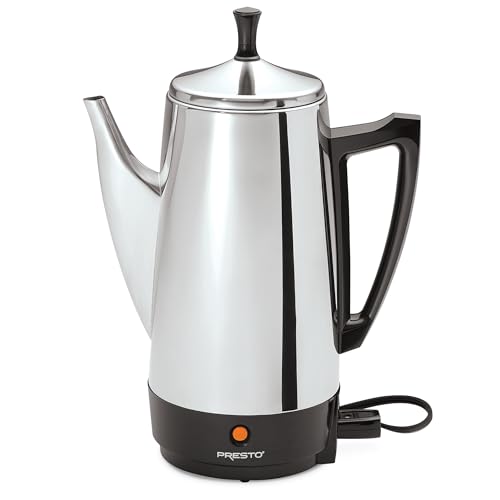
Another product you can consider if you want more coffee than what a Bialetti can give you is a percolator. Presto makes a stainless steel percolator that can make from 2-12 cups, and is removable from its base for easy pouring.
But of course the best thing about this percolator is that it’s really just made out of stainless steel and sometimes glass. It’s also easy to clean up, and makes that fun percolator sound. My granny used to have one of these, and I still remember her using it at all the family get-togethers. Our community center also uses a large percolator, which the goto method for large groups of people.
If you go the percolator route, you may want to get a programmable smart plug, so it’s ready for you in the morning when you wake up. I use a smart plug for my espresso machine, which needs 20 minutes to warm up, and it’s super convenient. I set it to turn on at 5 am, and by the time I’m downstairs at 5:30, the machine is ready.
What about Pour Over? Inherently Plastic-Free Coffee Makers
If you want a super clean brew, and don’t mind brewing one cup at a time, a manual pour over brew might be just right for you. Just know that it requires a little time and skill to learn, but it’s also a very fun way to make coffee. Keep in mind that you’ll want freshly roasted beans, and a decent burr grinder.
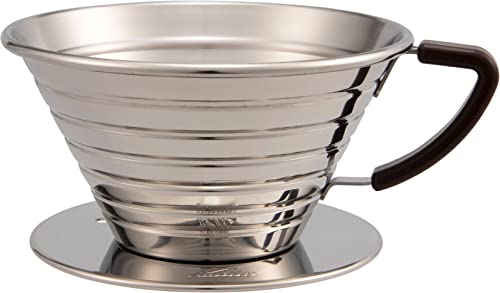
They make drippers in all different materials and shapes, the most common being plastic. However, you can also get pour over coffee drippers in glass, metal, and porcelain. Two very famous manufacturers are Hario and Kalita, both out of Japan. They make many different types of brewers, but I find the Hario Switch to be the most versatile. It’s made out of thick glass, a stainless steel ball, and a rubber bottom portion (as the valve opening).


How about Camping?
If you’re going camping, you have a few different options. First of all, you could take a Bialetti Moka pot with you – a tried and true brewer that is very robust and uses no plastic. We took one with us on our 3 week camping trip in Alaska, and it was a lifesaver! We just packed it full of water and coffee in the mornings, bleary-eyed, and put it atop our little gas burner. 5 minutes later we had our strong coffee to begin the day.
Otherwise, you could use a Bozeman camping percolator. This also uses no plastic, and since it’s made out of stainless, there’s no aluminum either. Win-win. I do find however, that of the two brewers, the Bialetti is the easier one to clean the grounds out of.
Summary of Coffee Makers with little or no Plastic:
I know that many people want to avoid plastic in their espresso and coffee machines. Thankfully, there are ways to avoid plastic in your coffee machine, and certainly it’s easier to do than in espresso machines. I wrote an article about that here.
If you want an automated option, I would say that the Technivorm Moccamaster is the best option, although it does still use BPA free plastic. It does make excellent coffee though, and is made of metal and glass besides the water reservoir and dripper.
Maybe the best option is the Bialetti Venus, which is a stovetop coffee maker that uses stainless steel in its construction, and it’s pretty cheap. It also makes a very nice, strong coffee.
Finally, pour over drippers are fun to play with, and you can choose between various materials and shapes.
Thank you for taking the time to read this article, and I hope it was helpful. Good luck finding your next coffee machine, hopefully with little to no plastic!
Plastic free espresso machines
So essentially, it seems the more expensive Italian-built and German-built machines use the least amount of plastic inside. Just the water tank, and the hose leading from the tank to the pump are the plastic parts still included.
Have a look below at some examples of espresso machines with less plastic involved:
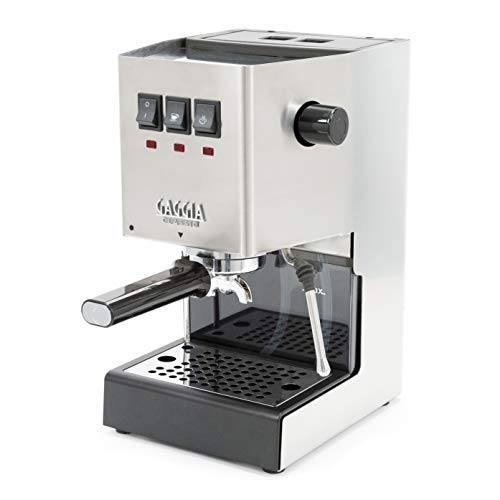
Gaggia Classic Pro e24: an absolutely iconic espresso machine, now with brass boiler with the e24 version, and metal tubing going to the steam wand. Brew group has a metal water dispersion plate. Uses hard plastic for the water tank and silicone tube to the pump, but hot water is handled with metal tubing.
Rancilio Silvia: a classic Italian espresso machine in many people’s households. Brass boiler and metal tubing to the steam wand. Uses plastic for the water tank and silicone tube to the pump, but hot water is handled with metal tubing.
Rocket Appartamento TCA: The Rocket Appartamento is probably the best known heat exchanger machine, with loads of steam power, E61 brew group, and very handsome looks. It is built similarly to the Rocket Giotto pictured above, with copper tubing for the hot water lines. It is however, much pricier than the Gaggia or Rancilio.